3. Pap and Grandma
 It’s impossible to overstate the importance
of Pap and Grandma in our lives. They were like an extra set of parents. We
were lucky that they were so young (Pap was just 43 and Grandma 42 when I was
born). Grandma died in 1972, when I was 32, and Pap in 1991, when I was 50. They
saw and participated in most of the significant events in my life. That's an
extraordinary thing. For most of our life together
they were vigorous and lots of fun. They saved us on more than one occasion
when we didn’t even have enough money to buy food. And they made it possible
for me to go to college. I had a scholarship, but it was Pap and Grandma who
supplied my meal money, clothes, transportation, and whatever else I needed. I
like to think I would have managed it anyway, but they made it a
certainty. They were so proud of me.
Sometimes, particularly in grad school, it seemed I’d never finish and I might
have quit, but I never could have explained it to them.
It’s impossible to overstate the importance
of Pap and Grandma in our lives. They were like an extra set of parents. We
were lucky that they were so young (Pap was just 43 and Grandma 42 when I was
born). Grandma died in 1972, when I was 32, and Pap in 1991, when I was 50. They
saw and participated in most of the significant events in my life. That's an
extraordinary thing. For most of our life together
they were vigorous and lots of fun. They saved us on more than one occasion
when we didn’t even have enough money to buy food. And they made it possible
for me to go to college. I had a scholarship, but it was Pap and Grandma who
supplied my meal money, clothes, transportation, and whatever else I needed. I
like to think I would have managed it anyway, but they made it a
certainty. They were so proud of me.
Sometimes, particularly in grad school, it seemed I’d never finish and I might
have quit, but I never could have explained it to them.
Pap, Albert Roy Bollinger, and Grandma, Minnie Mae Chamberlain Bollinger, were Mom’s parents. Pap was a barber and was somewhat insulated from the financial ups and downs of the time. They weren’t rich, but were usually comfortable, at least in my memory. Of course, Pap supplemented his income by dabbling in the numbers racket, which led to several brushes with the law, much to Grandma’s dismay. I know about most of this second-hand, though I do remember Pap, on more than one occasion, hustling across the street from the barber shop to hand a suspicious brown paper bag to the driver of the Chestnut Ridge bus as it passed by. And, more than once, he just happened to win a few hundred when we needed it, including a couple of occasions when I was in college.
Pap was a big man, at least by the standards of the time. He stood about 5’9” and had a tendency toward heavy, sometimes weighing over 200 pounds. Grandma, on the other hand, was a little bitty thing. She was 4’11” tall and seldom weighed more than 110 pounds. But there was no doubt who ruled that house. Grandma was the boss and everyone knew it. She just had a way about her. It was impossible to argue with her, because she simply refused to recognize that there was an argument.
Pap and Grandma were great joiners. Grandma belonged to the Mary Martha Sunday School class, the VFW Ladies’ Auxiliary, and a women’s club whose name I’ve forgotten. The latter was not any of the well-known clubs. Rather, it consisted of Grandma and seven or eight of her closest friends. They’d gather once a month to gossip, eat dessert, drink coffee, and play bunco, a dice game whose point and rules I’ve forgotten, even though I was pressed into service more than once when someone was missing.
Grandma’s great passion was bingo. She went to bingo at least once a week. The American Legion and the fire department’s Drum and Bugle Corp raised quite a bit of money with their bingo games. Often, she’d take me along. The best part was after the bingo, when we’d go to Foster’s Restaurant with Grandma’s friends and she’d buy me a banana split. Even now, more than fifty years later, when I taste a banana split, or hear songs like “My Happiness” or “There’s a Tree in the Meadow,” suddenly I could be sitting next to Grandma, eating my banana split and hearing her laugh.
As for Pap, he was assistant chief of the Derry Volunteer Fire Department and drill sergeant of the Department’s Drum and Bugle Corps. When I was in high school, the corps traveled to New York, where they placed sixth in a national contest. We actually saw Pap and Grandma outside the windows of the “Today Show.” Pap also belonged to the Eagles, the VFW (he was a veteran of World War I), the Westmoreland County Fire Chiefs’ Association, and heaven knows what else. I can still remember him trying to put on his pants while going down the steps when the fire whistle blew in the middle of the night. One of his delights in his old age was riding in the fire engine in all the local parades. On his 90th birthday, his friends brought the fire engine to his house to drive him around the block. He was so proud.
Pap never would talk about the war. He served in France and was wounded in the leg, which gave him trouble occasionally for the rest of his life. He also was gassed (chlorine, I think), but fortunately, not seriously. He had his old army uniform, a heavy, uncomfortable-looking thing made of wool, a bugle that he got in England, and an empty hand grenade, much of which is on display at the American Legion in Derry. But whenever I’d ask him about the war, he’d just change the subject. Even so, he took to calling me “Sergeant” and I called him “General.” We both got quite a kick out of that, though I don’t exactly know why.
Pap closed his shop on Mondays, which happened to be washday in Derry. So he and Grandma would do the wash together. Of course, they never did anything together without some kind of argument. Many’s the time I heard Grandma say, sharply, “Albert! You be careful with that blouse!” as Pap was feeding it through the wringer. He’d always come back with something like “Dammit, Minnie! I’ve been doin’ this for forty years! I know how!” But, however much they might argue, they were devoted to each other.
Pap always had a garden, though the size decreased with the passing years. I often helped him in that garden, pulling weeds and such. He'd reach down and pick a tomato or pull up a carrot and we'd eat it on the spot. Grandma would yell at us to wash the vegetables before eating them, but Pap would reply "Oh, Minnie, he's got to eat a peck of dirt in his life, so he might as well get started!" They had a grapevine about 15 or 20 feet long and three sour-cherry trees. When I was a teenager I'd pick the cherries for Grandma so she could make cherry pie. She also canned cherries, as well as tomatoes and pickles. I remember when she was invited to pick some pears from a friend's tree. Unfortunately, the branches were too high for our ladder and the tree was impossible to climb. So I took one of her clothes props (used to prop up the clothesline and keep the clothes off the ground when she hung them outside) and nailed a one-pound coffee can to the end. You could pick pears with it by maneuvering the pear into the can, then pushing up until the stem broke. I was pretty proud of my "invention".
 Pap and Grandma
were generous to a fault. At various times, it seemed that half the family
stayed with them when they were down on their luck. Of course, that’s the way
things were done in those days. I remember that Pap’s brother, Chuck, and
Grandma’s brother, Roy, lived with them when they needed help. And when Uncle
Roy’s first wife died, leaving him with two young daughters, Rhoda and Nancy,
it was Pap and Grandma who took them in for several years until Uncle Roy could
care for them again. We all remained very close until time and distance finally
separated us. Even now, they send cards to Mom from time to time, much to her
delight. And Grandma Chamberlain, Grandma’s mother, lived with them for a
number of years. She and I used to talk quite a bit and I guess I was one of
her favorites. I remember her, sitting in the armchair by the side window in
the living room, crocheting doilies of various kinds. I still have one of her
handmade quilts. When I was a junior at Carnegie, Mom called to tell me that
Grandma Chamberlain was in a coma in the hospital and I should come home if I
wanted to see her one last time. So I hurried home, went into her room, and
said “Hi, Grandma.” With that, she opened her eyes and said “Hello, Curtie.”
And, in a few days, they sent her home. Two years later, at Thanksgiving, she
died at the age of 89. I was somewhere in Ohio, on my way home from Wisconsin,
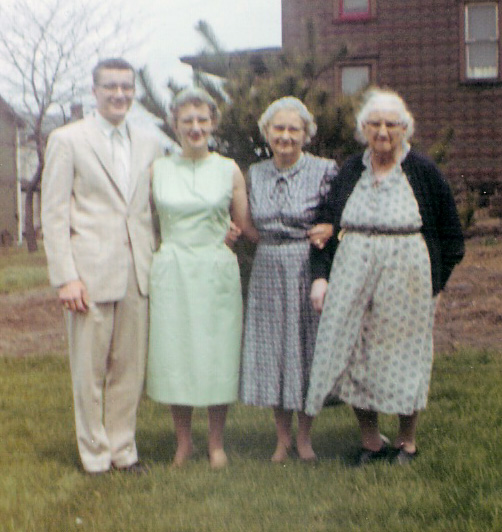
just a few hours short. The picture shows me with Mom, Grandma, and Grandma
Chamberlain, probably around 1958.
Pap and Grandma
were generous to a fault. At various times, it seemed that half the family
stayed with them when they were down on their luck. Of course, that’s the way
things were done in those days. I remember that Pap’s brother, Chuck, and
Grandma’s brother, Roy, lived with them when they needed help. And when Uncle
Roy’s first wife died, leaving him with two young daughters, Rhoda and Nancy,
it was Pap and Grandma who took them in for several years until Uncle Roy could
care for them again. We all remained very close until time and distance finally
separated us. Even now, they send cards to Mom from time to time, much to her
delight. And Grandma Chamberlain, Grandma’s mother, lived with them for a
number of years. She and I used to talk quite a bit and I guess I was one of
her favorites. I remember her, sitting in the armchair by the side window in
the living room, crocheting doilies of various kinds. I still have one of her
handmade quilts. When I was a junior at Carnegie, Mom called to tell me that
Grandma Chamberlain was in a coma in the hospital and I should come home if I
wanted to see her one last time. So I hurried home, went into her room, and
said “Hi, Grandma.” With that, she opened her eyes and said “Hello, Curtie.”
And, in a few days, they sent her home. Two years later, at Thanksgiving, she
died at the age of 89. I was somewhere in Ohio, on my way home from Wisconsin,
just a few hours short. The picture shows me with Mom, Grandma, and Grandma
Chamberlain, probably around 1958.
If you exclude sleep time, I probably spent as much time at Pap and Grandma’s house as I did at my own. Of course, they had a house with a huge yard, while we lived in apartments. Much of my young life was spent in that house, and I can still close my eyes and picture it in great detail. I knew, vaguely at the time, more clearly later, that it was a little shabby. The carpets were worn, as was the furniture. The kitchen was so tiny as to be laughable by modern standards, yet Grandma managed to feed as many as ten people on a more-or-less regular holiday basis. In high school, I spent many an afternoon in that kitchen, talking with Grandma as she fixed me an early supper (usually macaroni and cheese), so I could catch the team bus to a basketball game.
 The dining room
was more than cramped with its load of furniture – a refrigerator (there was no
room in the kitchen), a large table, a buffet, a china cabinet, a sewing
machine, and assorted chairs. Yet we all managed to fit ourselves into it,
along with various relatives from Pittsburgh. Grandma’s sisters, Claire and her
husband Bill Clary, and Lily and her husband Oscar Holmquist, frequently came
to visit, especially on the holidays. In the summer, we often had visits from
Grandma’s brother, Roy Chamberlain, his wife Beck, and their daughters, Betty
Jean, Peggy, Nancy, and Rhoda, along with their husbands and children. (In the
picture at right, Mom is on the left and Betty Jean on the right.)
The dining room
was more than cramped with its load of furniture – a refrigerator (there was no
room in the kitchen), a large table, a buffet, a china cabinet, a sewing
machine, and assorted chairs. Yet we all managed to fit ourselves into it,
along with various relatives from Pittsburgh. Grandma’s sisters, Claire and her
husband Bill Clary, and Lily and her husband Oscar Holmquist, frequently came
to visit, especially on the holidays. In the summer, we often had visits from
Grandma’s brother, Roy Chamberlain, his wife Beck, and their daughters, Betty
Jean, Peggy, Nancy, and Rhoda, along with their husbands and children. (In the
picture at right, Mom is on the left and Betty Jean on the right.)
I remember one visit in particular. Betty Jean had been visiting for a few days and her husband, Henry, was to pick her up on the weekend. Well, on Saturday, Henry, his brothers, and Uncle Roy went to a Pirates baseball game. We had the game on the radio when it was announced that there was a fight in the stands and several fans had been arrested. I think the announcer read the names and we were startled to find that Henry and Uncle Roy were among them (Betty thinks that Uncle Roy actually started the fight). Next day, there was a story in the Pittsburgh paper. That sure tickled Pap.
Mom, Judy, and I occasionally visited Betty, Henry, and their kids, Janet, David, and Johnny, at their home in Moon Twp., I think, near Coraopolis, which was just west of Pittsburgh. In those days before freeways, that trip of about 60 miles took nearly two hours. But we had a great time. On other occasions we would visit Uncle Roy, Betty's father, who lived on a hill in Coraopolis, as I recall.
Oh, we could stuff that house! But Grandma just laughed her little laugh and went about feeding us all. The treat for us kids was when we just couldn’t fit everyone into the dining room and we got to eat by ourselves at the kitchen table. Uncle Bill Clary invariably pronounced it “the best damned ham (or beef or turkey) I ever ate.” Grandma would blush and say she had her doubts as to the amount of salt in the dressing, or some such comment, but you could tell she was pleased. After that, the men went to the living room, while the women cleared the table and “read up” the kitchen. (I think that’s a corruption of “ready up,” but I don’t know for sure.) The afternoon was spent in conversation and catnaps. About six o’clock Grandma would fix a “snack” of cold leftovers and the inevitable cake or pie. After that, the dining room table often became a card table for a friendly game of penny-ante poker. What times we all had!
The living room was equally crowded with furniture and Grandma’s beloved knick-knacks. Once, when I had nothing to do, I borrowed a plaster plaque of Abraham Lincoln from Grandma Heacox and made a mold of it out of modeling clay. Of course, the clay had to be kept cold, so it occupied a corner of Mom’s refrigerator for several years. I made a plaque from that mold, painted it in lifelike colors, and gave it to Grandma. I believe it’s still on the wall after nearly fifty years. She couldn’t bear to throw away anything we made for her. Of course, as I write these words, I’m looking at a small tin box on my desk. It’s painted gold and has a heart on it. I have another at the office. Also on my desk is a handmade pot that holds my pens and pencils. And somewhere, I think I still have a set of bookends and a pencil holder made of birch logs. I guess you just can’t beat bad genes.
The living room had a set of French doors leading into the entrance hall. The couch always sat across one side of the room, in front of the windows. At one end of the couch, there sat a radio in a squat, wooden cabinet. There was just enough room between the radio and the French doors for a young boy to lie on the floor and listen. I spent many hours in that cozy corner.
My most enduring memory of that house is of warmth. It always seemed so snug and cozy. When we were young, staying overnight at Pap and Grandma’s house was one of life’s great treats, especially in the days before they got the gas furnace. Then they heated with coal, so the house got pretty chilly on a winter’s night. In the morning, Pap would head for the cellar to get the furnace going, while Grandma would light the little gas stove in the bathroom. Once the room was good and toasty, she’d call us and we’d run through the chill morning air to that warmth, where we’d get dressed. When we stayed there, the great contest was over who would get to sleep in the “little room,” the smallest of the three bedrooms. There was nothing to distinguish it, but it just seemed to fit us as children. Anyway, warm it was. Sometimes it seems that I can reach out and it will be just as it was, full of warmth and the smell of Grandma’s cooking and the sound of Pap’s laughter.